Another article on managing volunteers
Recruiting volunteers
Written by John Berry on 19th February 2026.0
5 min read
 Once the job description and person specification are available, combined perhaps as a job description/person specification (JDPS), recruitment can start.
Every CSO will recruit in a different way. There is no prescriptive ‘best practice’. There are however elements of the process that are key to success. If these elements are not given due care and attention, the recruitment process will fail. The seven stages of our process are shown in the attached figure.
This process is somewhat more scientific and considerably more robust than that done by most CSOs and recruitment consultants.
The first stage is to develop the job roles. Remember that we’re being quite definitive here – a role is a discrete part of a job that will have its own responsibility or responsibilities. And where relevant, several roles aggregate to make a complete job.
The job description and person specification, the JDPS, is developed by asking the question, ‘what characteristics are needed for the volunteer to perform well in those roles?’ The ideal profile and selection criteria are produced for use later in the process.
The search criteria are defined in practical terms and describe the characteristics that the search agent will look for and advertise for – attributes like experience in a particular field, or likely qualifications. The search criteria are not selection criteria. Selection criteria are used later in the cycle.
Managers of volunteers often dislike asking for tangible evidence of competence, and we’d agree that sometimes qualifications and the like can wrongly imply competence. Nonetheless, they are an effective way of removing search agent personal bias. They avoid search agents responding emotionally to vague candidate CV and LinkedIn profile claims like, “an effective team player”, or “a mindful innovative thinker”.
The search criteria feed into the skirmish, Stage 3. In Stage 3, the search agent has a look in the volunteer market to see if what’s wanted exists. Many CSOs launch full scale search activities, only to fail because what they asked for was not available. This stage allows change to be made following learning from the skirmish. What’s done here will depend on the job and the CSO, but the aim is to be sure that once a full search project starts, it will be successful.
Search begins once the manager and search agent agree that it’s likely to be successful.
The search activity, Stage 4, is described at length elsewhere on this site and in our books and we discuss the merits of the various sources of candidates that might be used. As we indicate, the outputs at this stage are candidate volunteers and their metadata gleaned by search agent telephone discussions. Those discussions focus only on the search criteria – search agents are unlikely to be qualified in selection. It would be wrong at this point to make any judgement other than that the candidates meet the search criteria.
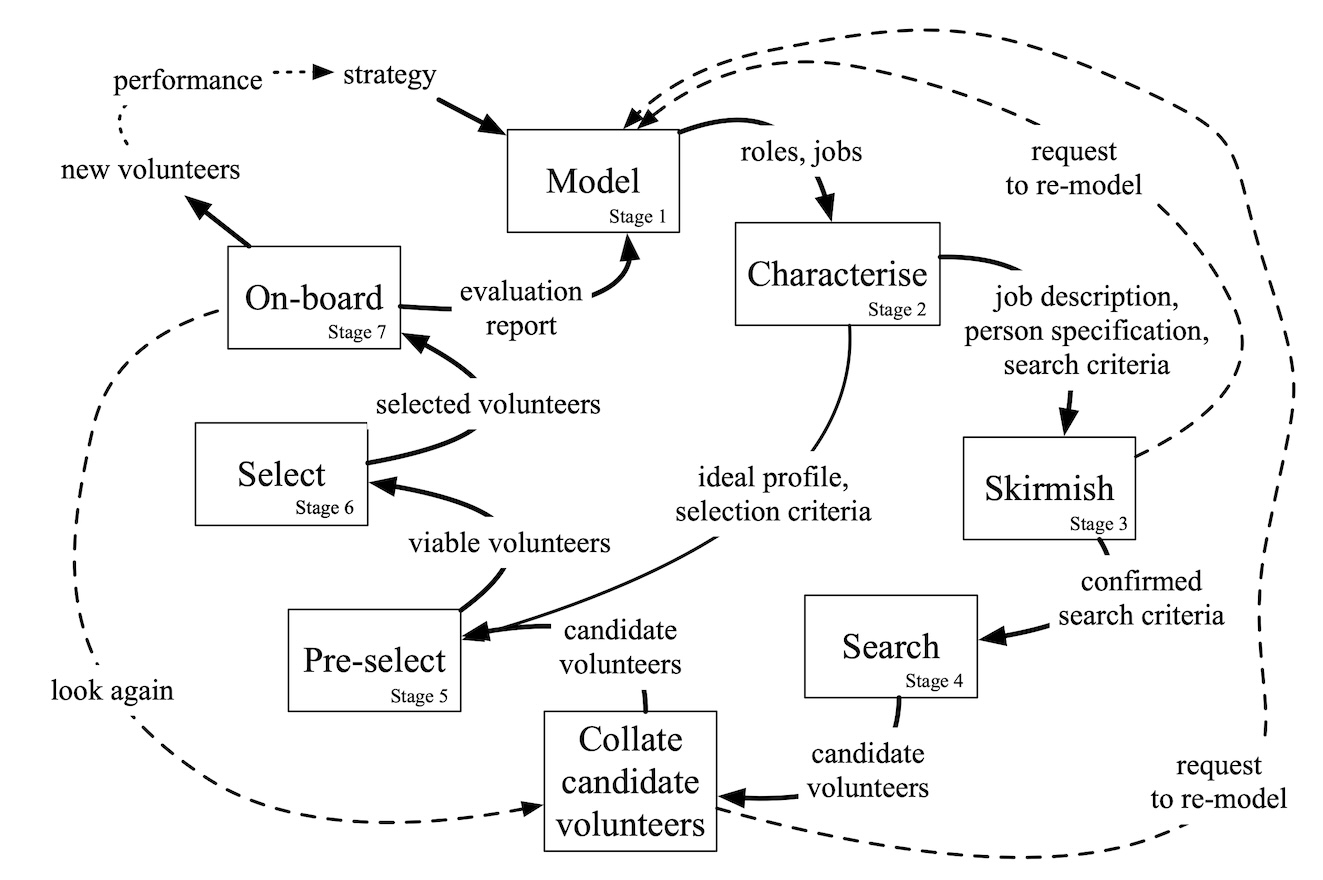
Once candidate volunteers are identified, we recommend a two-stage activity where candidates complete light psychometric assessment and work sample tests. The main selection (Stage 6) can begin with its two-step interview or perhaps assessment centre.
Decisions at both pre-selection and selection stages are made using the selection criteria and the ideal profile developed in Stage 2. If a candidate is deemed to substantially meet the selection criteria, they are a viable candidate to whom an offer of a volunteer job might be made.
There are many versions of Stages 5 and 6. Generally, we prefer the first interview to be informed by the preselect tests and to be a light-weight discussion aiming to convince the candidate that the CSO is great to volunteer with and the volunteer job is interesting. Some managers (either when faced with huge numbers of applicants, or because they think using technology is helpful) will design an application portal and candidates will need to pass pre-selection before progressing to first interview.
Generally, the second interview is the ‘big one’. It’s there that the candidate will face full a psychometric assessment, work sample tests and scenario interviewing. Second interview testing asks, ‘can this candidate do the job?’ Second interview testing should have high predictive validity and be objective. We discuss the merits of the various selection activities later. And we discuss how interviews and other formal selection methods may be changed or may even be unnecessary.
Then it’s on to managing the on-boarding process, Stage 7, to make sure the chosen volunteers join.
Now a question. Should a manager interview candidate volunteers?
We’ve described a rational stepwise approach. The manager has search criteria and can work with their marketers to publicise the jobs. They can task agents to search, whether on LinkedIn, on existing databases, or by asking existing volunteers as friends of candidates. They can advertise in magazines and local radio or wherever they identify that success will be likely. And if they elect to use conventional interviews or assessment centres, they can select.
But should they? Should they interview? We discuss this big question elsewhere, and in our book Achieving with Volunteers.